
Spartanburg Previous Residents by Era
A backward trail has several channels, each with a different purpose. The Register of Deeds supplies recorded transfer information. Old index books and the Register counter take the work beyond the free online image spans. Digitized city directories and the Kennedy Room provide dated name-and-address appearances. The federal census supplies a released household snapshot, and the State Archives has deeper probate and conveyance series. Begin with the source closest to the period in question, then test its result with the next independent source rather than treating one hit as a full address history.
| Source | Years It Covers | Where Held | What It Shows |
|---|---|---|---|
| ROD free online deed images | Most deeds 1970-present | Register of Deeds Document Search | Recorded transfer parties, legal description, book/page |
| ROD Old Deed Index Books | Portal labels include 1785-1919, 1919-1959, 1923-1969, 1960-1969, and 1976-1979 | ROD portal and counter | Index route to an older instrument |
| SCPL digitized directories | Selected, noncontinuous 1880-81 to 1956 | SCPL ContentDM and Kennedy Room | Dated household, address, and occupation appearance |
| Federal census | Public release through 1950 | National Archives or library genealogy access | Decennial household snapshot near a directory year |
| SC Archives probate papers | Estate 1787-1900; wills 1810-1903; real estate 1825-1904 | SCDAH guide and Research Room | Heirs, executors, estate property, and transition clues |
Recorded ownership and occupancy are different questions. A deed may show a transfer without naming every household member. A directory may show a printed address without certifying title. The strongest result keeps the source date, record type, and parcel or address form in the same note. Note: A current tax record can trail a recorded deed, so verify any transfer through the recorded instrument.
Spartanburg Previous Residents and Parcel IDs
Start by normalizing the known address. County Addressing Inquiries offers Search Roads, Search Subdivisions, Search Addresses, and Find Address Range. These modes validate the County road and address system. They do not return names. Next, use Spartanburg County OneMap to locate the parcel and preserve its map or parcel number, legal description, deed book/page, instrument number, and sale date where shown.
OneMap instructions document searches by Parcel Number, Street Name, Address, and Subdivision Name. The Find a Parcel route accepts Parcel ID Number or Owner Last Name. After choosing a result, the blue result link pans to the mapped feature. Parcel layers, Address Points, feature identify, aerial imagery, measurement, and printing help preserve context. Those functions are a map-and-record route, not a list of prior occupants.
- Situs address
- The physical location of the parcel. It can differ from the tax mailing address and from an older printed street form.
- Parcel identifier
- The county map or parcel reference that helps keep searches tied to the same land when a street number changes.
- Legal description
- The lot, subdivision, metes-and-bounds, or similar recorded land description. It is often safer than a street number in old records.
Do not turn an owner or taxpayer field into a claim about who lived at the property. The County says its tax information can lag deed or plat processing, and it identifies the recorded deed as the official ownership source. For a full current street method, the Spartanburg Street Directory follows the address-keyed records separately.
Spartanburg Previous Residents Beyond Online Images
The Spartanburg County Register of Deeds Document Search is the online entry point for a backward property trail. The County’s published coverage says deeds are online from 1970, mortgages from 1990, and plats from 1992. Online copies in those stated spans are free. Before those image windows, the portal’s Old Index Books and the office become important. An index label can lead to a book, page, party, or instrument, but it is not a promise that every original image is freely available online.
Portal-labeled deed/index books include 1785-1919, 1919-1959, 1923-1969, 1960-1969, and 1976-1979. Mortgage labels span 1904-1934, 1935-1977, and 1978-1989. Plat labels span 1800-1973 and 1974-1992. The State Archives supplies a deeper route through Register of Mesne Conveyances books from 1785-1911, conveyance abstracts from 1785-1809, mortgage books from 1872-1906, Commissioner of Locations plats from 1802-1870, and recorded-instrument citizen copies around 1800-1879.
Open the Register of Deeds Document Search to begin an instrument search.
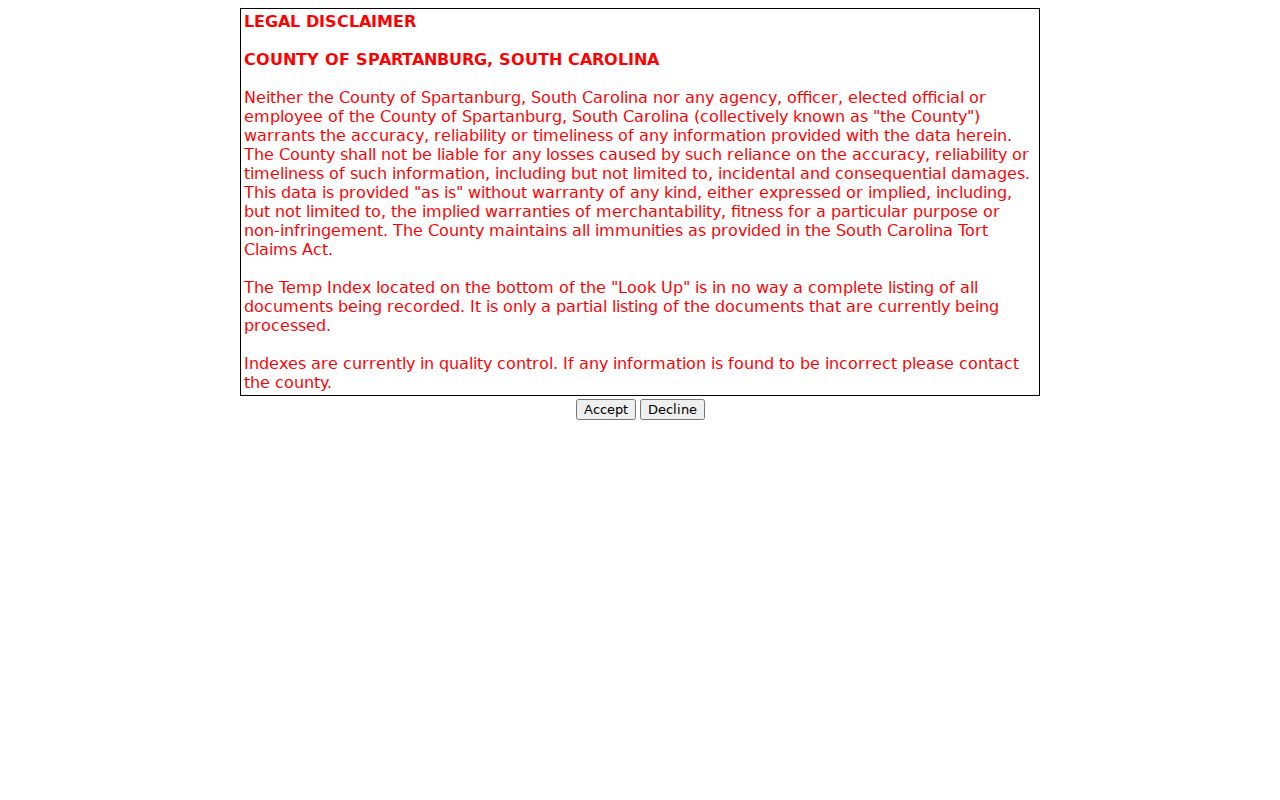
The entry screen begins the recorded-document route, while older work may continue through index books, the counter, a written copy request, or State Archives microfilm.
For copies, the County says a visitor may ask staff for help obtaining a document, while the Register does not perform title, restriction, or lien searches or give legal advice. A mailed request needs the book and page plus a check payable to the Register of Deeds. Ordinary copies are $0.50 per page and a certified copy is $10 per document. The office is at 366 N. Church Street, Main Level, Suite 100, Spartanburg, SC 29303, with telephone 864-596-2514.
Trace Spartanburg Previous Residents Through Deeds
A deed chain follows the property, not every person who may have lived there. Start with the current parcel’s recorded reference. Open the present deed using the book/page, instrument number, or party name. Preserve the legal description, subdivision or lot, and map/parcel clue as you move backward. On a recorded deed, the grantor is the party conveying property and the grantee is the party receiving it. Searching a prior owner as a later party can reveal that person’s earlier purchase.
- Validate the address and capture the parcel number, legal description, deed book/page, instrument number, and sale date from the mapped property record.
- Retrieve the current recorded deed through the Register index and identify the current grantee and prior grantor.
- Search the prior owner and use a derivation clause, book/page, or instrument clue to find the earlier conveyance.
- Repeat backward while comparing the legal description, lot, subdivision, and parcel identifiers at every change.
- When online images end, use Old Index Books, the Register counter, mail copies, or the appropriate Archives research route.
- Grantor and grantee
- The parties named in a transfer: grantor conveys, grantee receives. Their roles can change as a person later sells a parcel.
- Chain of title
- A sequence of recorded transfers for the same property. It requires careful comparison, not just a repeated surname.
- Derivation clause
- A deed reference that can point to an earlier recording date or book/page, helping link one transfer to a prior one.
Historic Spartanburg Addresses Need Context
Older directory and modern map entries may not line up word for word. The County maintains street and structure addressing for the 911 system, while City Planning lists an Address Change Request with a stated 3-5-day review time for a new parcel address or an existing property address change. When the number or road form appears different, compare the road and address range, historical maps, legal description, and deed book/page. Do not assume the same street number has always meant the same parcel.
Kennedy Room historical maps and Fire Insurance Maps Online access are useful fallbacks, but a Spartanburg Sanborn year run was not verified. OneMap identifies February 2025 imagery as current and says older 2004-11 datasets are being re-added. Aerial imagery and permit fields can raise a timing question about physical change. They cannot establish a legal boundary, recorded transfer, or past household. County OneMap permit fields include type, date, value, and number, while a public historical permit archive range was not verified.
Spartanburg’s historic districts and its railroad and mill-era growth are further reasons to keep names and address forms as printed. Historic neighborhood names can guide a directory, map, newspaper, or deed search, but they are not individual-address evidence. Note: Match an old address to the same legal description before combining its records with a modern parcel.
Past Spartanburg Households in Directories
After the deed trail identifies a property question, use the household layer for people who lived there before. The Spartanburg city directory collections are the local source for selected digital volumes, directory entry structure, and Kennedy Room access. Transcribe a name, address, occupation, and any lodging notation exactly as printed. Compare the closest volume before and after it. Then use the nearest released federal census as a separate decennial snapshot of household composition, age, birthplace, and address context.
The SCPL digitized Spartanburg city-directory collection is the online starting point for selected historical volumes.
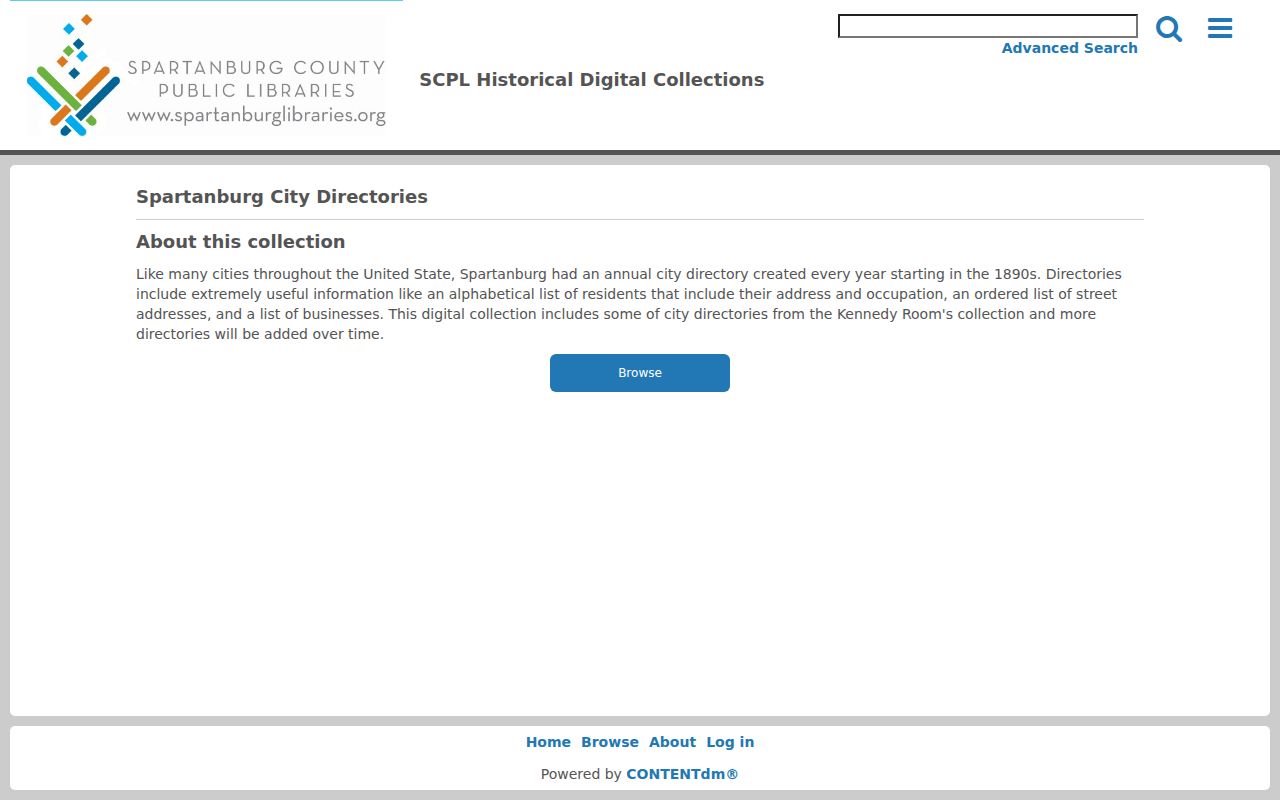
The browse screen helps locate a specific year, but a missing digital issue should be checked with the Kennedy Room rather than treated as a missing household history.
A simple sequence is: directory year, nearby directory year, nearest released census, then a death-notice or probate lead if the name leaves the address trail. The Kennedy obituary and death index starts with the 1844 Carolina Spartan and continues through current newspaper material, but 1923-29 is unindexed. The News Index has its own partial coverage. A no-hit during either gap is not proof that no event occurred.
Use the Kennedy Room local-history collection for the directory, newspaper, map, and microform fallback.
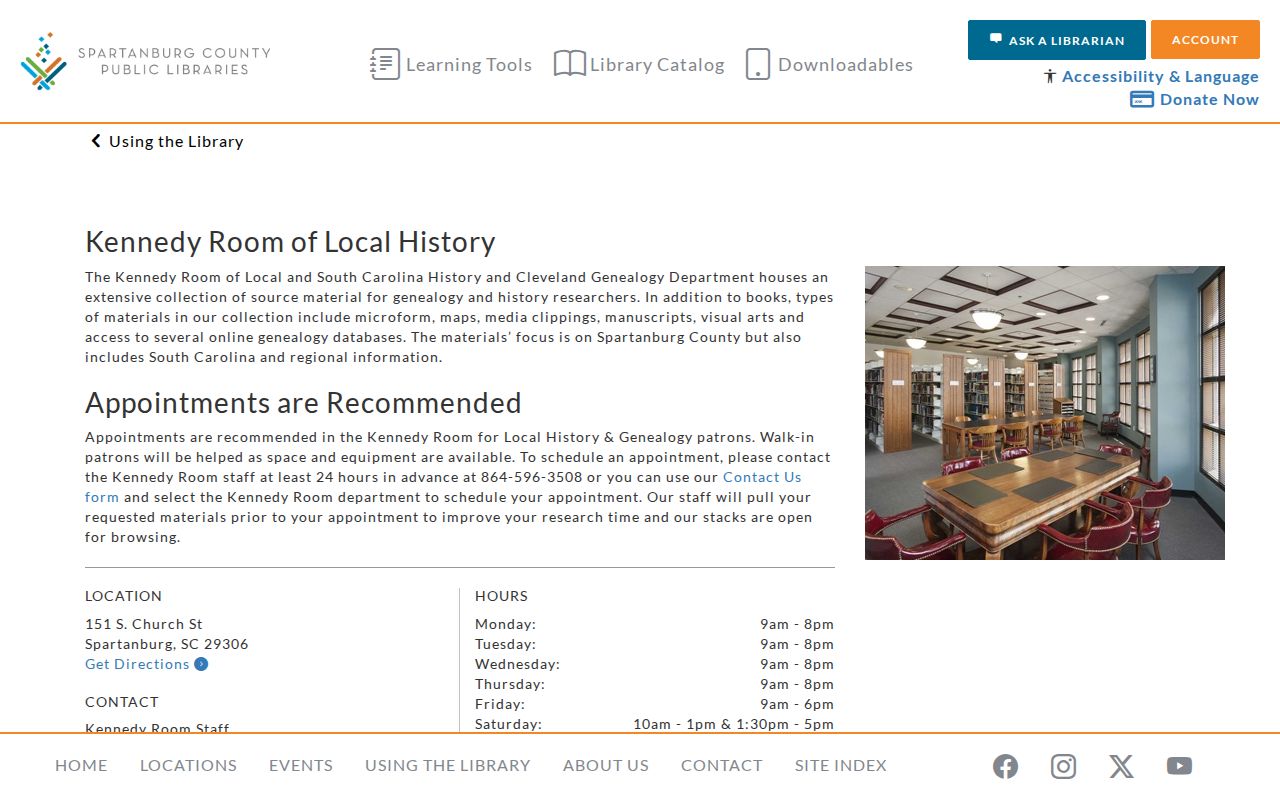
The collection can connect a dated address appearance to a staff-assisted newspaper, probate, or historical-map inquiry.
Lawful use. Spartanburg previous-resident research supports family, estate, and property-history questions. Do not use any record to stalk, harass, harm, or track a living person.
Spartanburg Property Chain Endpoints
A disappearance from an address can also point to an estate transition. The State Archives Spartanburg County guide identifies estate papers for 1787-1900, will books for 1810-1903, probate real-estate papers from 1825-1900, and probate real-estate books from 1825-1904. These older holdings can identify heirs, executors, estate property, or a deceased-owner transition. They do not replace a modern deed search and may require the Archives Research Room or a request after an index hit.
For current county matters, Spartanburg Probate Court is the local destination for estates, wills, guardianship, and marriage licensing. Probate context should be used to confirm an event or estate relationship within the custodian’s records, not to make a claim about everyone who may have occupied a property. The Kennedy obituary index can provide a newspaper citation, while probate records can explain a documented property transfer after death.
Spartanburg Previous Residents With Care
Property history stays accurate when each record keeps its own purpose. A tax parcel gives administrative owner or taxpayer information and may include a mailing address. A recorded deed documents a transfer. A city directory gives a dated printed appearance. A census gives a released household snapshot. A newspaper index is a citation-finding tool. If these sources disagree, preserve the conflict and use the custodian’s next access channel instead of combining details into a single unsupported story.
South Carolina’s address-confidentiality and records protections still apply. Some court material is sealed, some vital records have eligibility limits, and protected addresses must not be treated as ordinary public leads. Historical address research is not a reason to intrude on anyone’s privacy. Note: Record the source, date, page or instrument reference, and exact address form before drawing any historical conclusion.