
Spartanburg Resident Lookup Records
No Spartanburg office maintains one master roster of all residents. A resident lookup instead joins records that were made for different reasons. The Assessor and OneMap connect a name to a tax parcel. The Register of Deeds records a property transaction. The trial-court index places a party in a case. Probate handles estates and marriage licensing, while the state vital-records office has separate eligibility rules for certificates. Keeping the purpose of each record in view prevents a mailing address, an old deed, or a bare name from being mistaken for proof of current household membership.
| Record route | Useful confirmation | Custodian | Access boundary |
|---|---|---|---|
| Assessor property record | Owner or taxpayer tied to a parcel | Spartanburg County Assessor | Tax data can lag a recorded deed |
| Recorded document search | Party, legal description, book/page, or instrument | Register of Deeds | Online deed images begin in 1970 |
| Public Index | Party, case number, division, and case lead | Relevant court custodian | Index is not the official case file |
| Vital-record route | Eligible event record or historical index | South Carolina DPH | Eligibility and release periods apply |
| MySCVotes | A voter’s own registration information | State Election Commission | Identity details are required |
Choose the first route by the question. A transfer or property history calls for the deed and parcel path. A possible court matter calls for the correct court index and later confirmation with the clerk. An event record calls for DPH or Probate Court, not a general name search. Historical name-and-address work often begins with the Kennedy Room and the selected volumes described in the Spartanburg directory book.
Check Spartanburg Court Records
The Spartanburg County Public Index is the county trial-court lead for a person’s name or a known case number. It does not collapse every local court function into one result. The County Clerk of Court serves General Sessions, Common Pleas, and Family Court. Probate is the path for estates, guardianships, wills, and marriage licenses. Magistrate and City Municipal Court have different functions as well. Match the event to the forum before drawing any conclusion from a name result.
| Search clue | How it narrows a Spartanburg court result |
|---|---|
| County selection | Select Spartanburg to reach the local trial-court context. |
| Party name | Use the spelling found in a known record, then compare name variants cautiously. |
| Case number | Copy it exactly. Judicial Branch formats distinguish Circuit matters from Summary Court matters. |
| Division and case type | Use them to separate Circuit, Family, Probate, Magistrate, Municipal, and other functions. |
| Docket status | Treat it as an index lead and verify it with the court holding the file. |
The Public Index connection rejected a live test query during the research inspection. That is a reason to use the county clerk’s records contact or the relevant court counter when the online result is unavailable. Sealed, confidential, juvenile, family-sensitive, and expunged material is not something a name search can establish as open to the public.
Here is the Judicial Branch Public Index route for Spartanburg, which is the source captured for this court-name image.
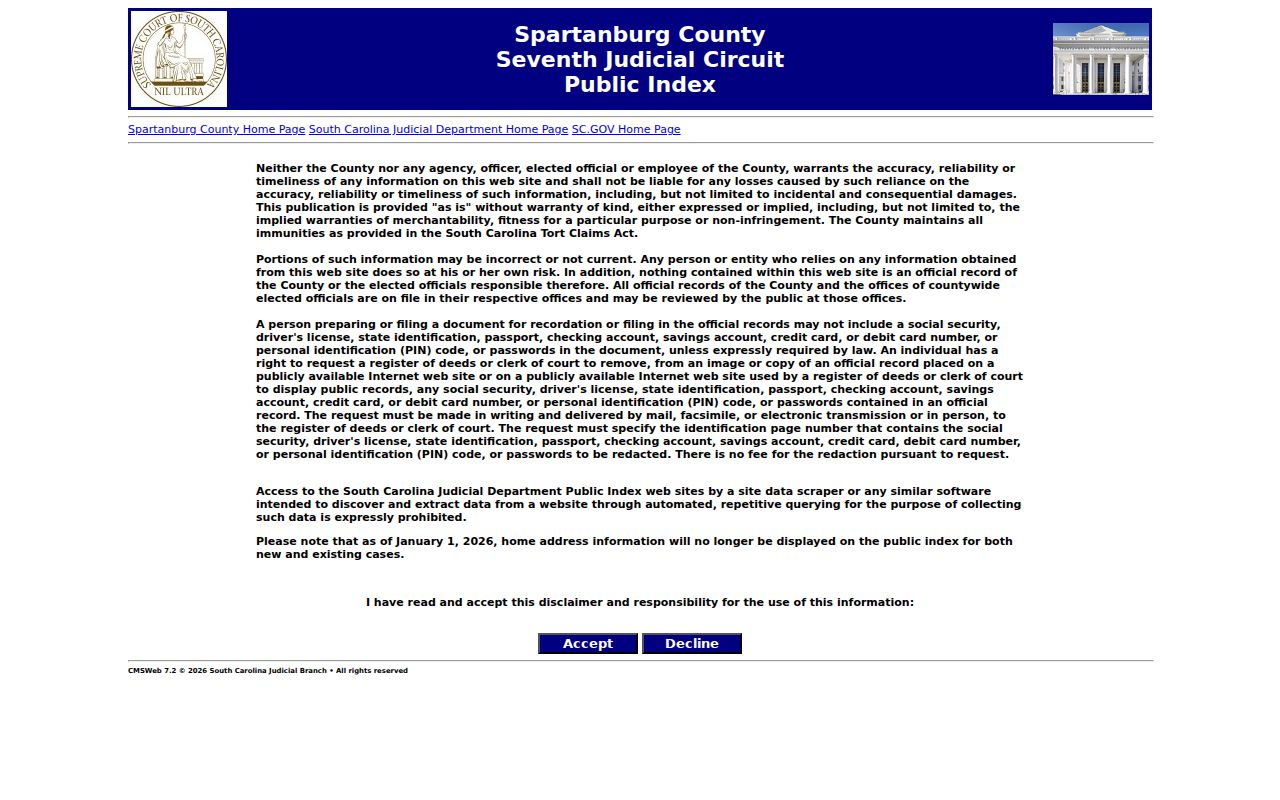
A case number, court division, and filing period make a much safer request to the Clerk than a name alone.
Note: A court index can identify a case lead, but only the relevant court custodian can confirm the official file or copy.
Spartanburg Vital Record Boundaries
South Carolina Department of Public Health is the vital-records custodian, and its local Spartanburg office is a channel for state records rather than a substitute for Probate or the Clerk. Birth certificates become public after 100 years. Death certificates become public after 50 years. Before those thresholds, a request needs the record-specific relationship, authority, or documented interest described by DPH. A historical index entry is not the same thing as a certified record.
| Record type | Spartanburg route | Historical access | Important limit |
|---|---|---|---|
| Birth | DPH Vital Records | Public after 100 years | Current requests require eligibility and identification |
| Death | DPH and its genealogy index | Public after 50 years; index covers 1915-1967 | Restricted copies have requester rules |
| Marriage | Spartanburg County Probate Court | County marriage records are viewable in person from July 1911 | Certified copies use the custodian’s process |
| Divorce report | DPH, then filing Clerk for a decree | DPH reports run July 1962 through December 2023 | DPH does not issue the actual decree |
For an adoption question, use DPH’s official adult-adoptee biological-parent information procedure. It has separate consent and eligibility rules. For a marriage license issued in Spartanburg County, Probate Court is the local route, and its public in-person viewing rule begins in July 1911. These narrow channels are more reliable than trying to infer an event from another kind of record.
Trace Spartanburg Probate Records
Estate research can add family and property context to a one-person records check. Spartanburg County Probate Court handles estates, wills, guardianships, and marriage licensing. A name in an estate filing may identify an executor, heir, or other participant, not a current occupant. Pair it with an address, parcel number, recorded document, or dated obituary before treating it as an identity match.
For a deeper historical trail, the South Carolina Archives guide lists Spartanburg probate estate papers from 1787-1900, will books from 1810-1903, and real-estate probate material beginning in 1825. The Archives research-room and request channels matter because an index hit does not promise that an image is online. The Kennedy Room’s death-notice index, which starts with the 1844 Carolina Spartan and has a stated 1923-29 gap, can help locate a date or family transition before a probate request.
Identity check. Preserve the name exactly as indexed, then carry a non-name anchor such as a parcel, case number, event date, or deed reference into the next search.
Spartanburg License Record Checks
Business and credential systems can clarify a narrow professional or entity relationship, but they do not prove where someone lives. The Secretary of State entity search offers Begins With, Contains, and Exact Match name modes, then leads to the entity profile and document requests. Its “Good Standing” label means the entity is not dissolved in Secretary of State records. It is not proof of current activity or identity outside that filing.
The South Carolina LLR Licensee Lookup is the state route for credentials regulated by an LLR board. Use a credential result only within that board’s scope, record the exact name and license context, and confirm the status with the issuing office when it matters. A name check is stronger when a credential or business result is paired with a separate official record.
The LLR Licensee Lookup is the source shown in this state license image.
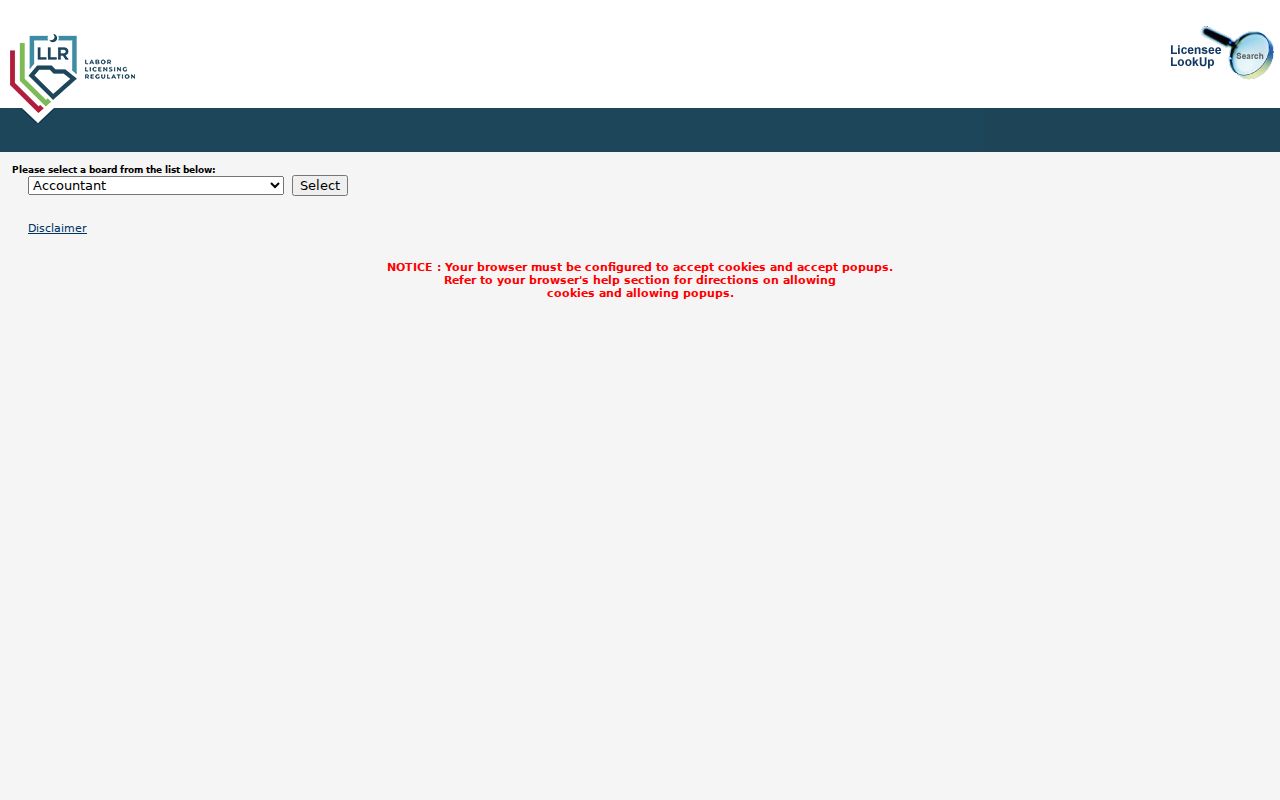
The portal supplies a credential-oriented check, so it should remain separate from a conclusion about a person’s present address.
Note: A business filing or credential confirms only the relationship and status its own custodian publishes.
Use Spartanburg FOIA Records
When an agency holds a nonexempt record but has no useful online index, the South Carolina Freedom of Information Act can be the written-request path. Spartanburg County accepts an online request, U.S. mail, and fax. A focused request should identify the record, date range, address or parcel, case number, or book/page. That helps the agency search a real record rather than asking it to create a new answer.
Under S.C. Code Ann. §§ 30-4-10 et seq., a public body generally gives its determination within ten business days, excluding weekends and legal holidays, or twenty business days for a record more than 24 months old. County rates are tied to the lowest-paid qualified employee’s search, retrieval, and redaction time plus copying charges. FOIA does not open a sealed court file, bypass vital-record eligibility, or override address-confidentiality protections.
The Spartanburg County FOIA page documents the local portal and mail-or-fax alternatives used when an online record check reaches a dead end.
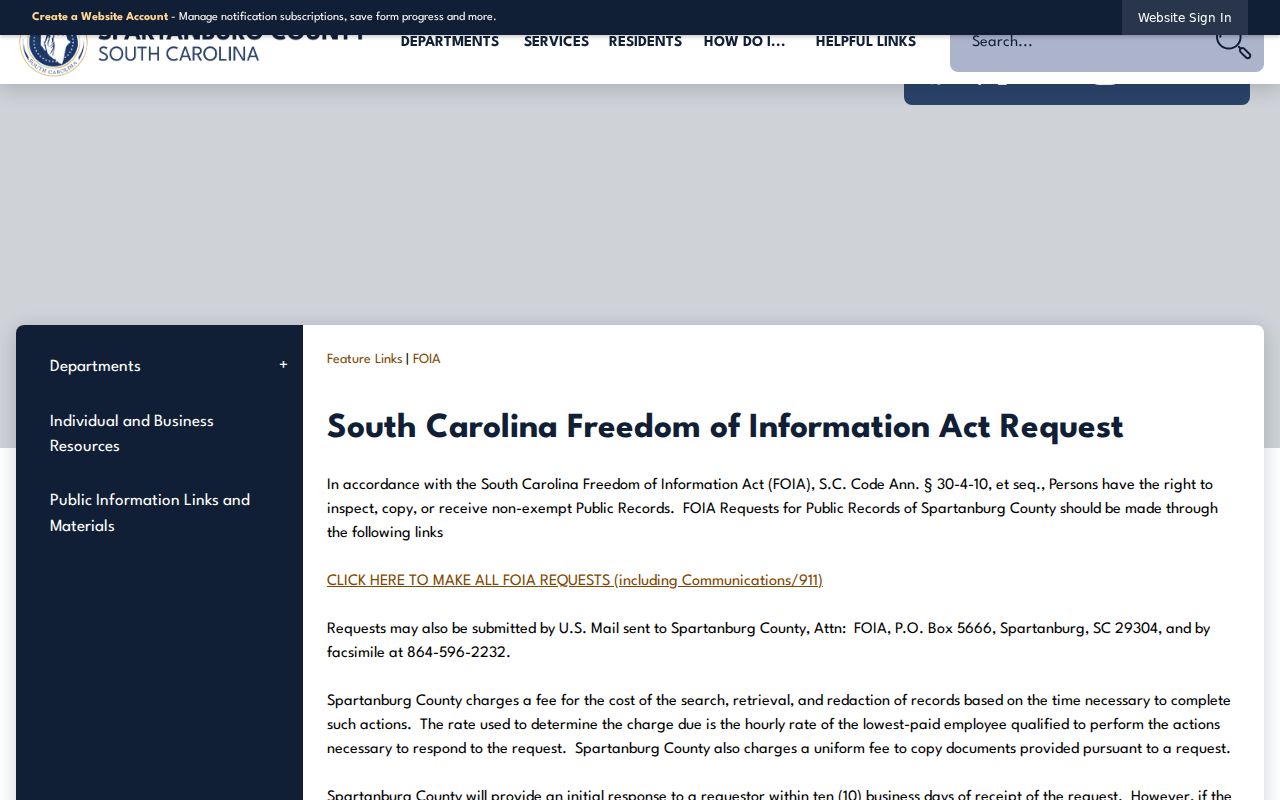
Give the county the narrowest useful description, then follow its published fee and response process.
Verify a Spartanburg Resident
A careful name check uses two records with different purposes. Begin with a record that has a date and an identifying context, then confirm that context in a separate custodian’s system. An address is useful only when it is labeled clearly as a situs address, tax mailing address, or historical directory appearance. The County specifically warns that the Assessor’s ownership information can lag a recorded deed for months, so the recorded transfer controls a property-ownership question.
- Write down the exact indexed name and the non-name detail already known, such as an address, parcel, court number, or date.
- Use the matching official portal to find the record’s own identifier, such as a parcel number, book/page, instrument number, or case number.
- Check a second custodian that serves a different purpose. For example, compare a tax parcel with the recorded deed rather than treating the tax display as final.
- Ask the custodian for the exact file or certified copy only when the record’s eligibility and access rules allow it.
- Docket
- A court’s running list of filings, events, and status in one numbered case.
- Index and image
- An index points to a record. An image is the scanned document itself, and it may have different access rules.
- Certified copy
- A copy issued or certified by the record custodian for the purpose the custodian allows.
- Situs address
- The parcel’s physical location, which is distinct from a taxpayer’s mailing address.
A conflict between records is a reason to ask the right custodian for clarification. It is not a reason to merge two same-name results silently.
Spartanburg Resident Record Privacy
South Carolina privacy rules depend on the record. S.C. Code Title 30, Chapter 2 restricts specified personal information and provides redaction treatment for official web records. The Register of Deeds allows a no-fee written request to remove specified identifying or financial data from publicly available web images when the page containing it is identified. That process changes web display, not the fact that the underlying custodian record exists.
The Address Confidentiality Program under S.C. Code Ann. § 16-25-130 gives qualifying victims a designated address for agency and court use, subject to statutory exceptions. Since January 1, 2026, qualifying current or former officers and judges may also seek agency-by-agency online limits for specified contact and tax-map information. A missing address may therefore be intentional. Request correction or redaction from the agency that holds the record, rather than attempting to work around a protection.
Public documents can also be used in impersonation attempts. A September 16, 2025 County notice announced free Register-of-Deeds property-fraud alerts for a document recorded under an enrolled name. Treat an alert as a prompt to check the recorded document and contact the Register of Deeds with copy questions, not as a substitute for confirming the record itself.
Lawful use. Use Spartanburg resident records for personal, lawful research only. Do not use any name, address, or record detail to stalk, harass, threaten, or harm another person.