
Spartanburg City Directory Collection Trails
The SCPL historical directory collection at Spartanburg County Public Libraries is the strongest local historical shelf. Library staff describe annual directories beginning in the 1890s, with alphabetical resident lists, street-address material, and business listings. The online group is selective. A missing browse year does not prove a directory was never printed or that the Kennedy Room lacks a physical or microform copy. For a historical name, use a nearby scanned volume, preserve the printed spelling and address, and then ask library staff about the gap.
| Collection | Years | Where Held | Access |
|---|---|---|---|
| SCPL digitized historical volumes | Selected, noncontinuous 1880-81 through 1956 | SCPL ContentDM and Kennedy Room | Free browsable page-image volumes online |
| Kennedy obituary and death index | 1844-current newspapers; 1923-29 unindexed | Kennedy Room search, microfilm, and staff | Index and retrieval path, not a directory |
| Kennedy News Index | 1915-22, 1931-37, 1950, and 1960-present | Kennedy Room | Local news citation and context |
| SC Archives county probate series | Estate 1787-1900; wills 1810-1903 | Archives guide and Research Room | Historical estate and family-transition research |
The table separates a directory appearance from a later record of death, estate, or family change. A directory may show an address and occupation for one published period. Probate material may document an executor or estate property during a later transition. Neither proves a present connection. Note: Selected digitized volumes are useful entry points, but the collection does not promise uninterrupted annual coverage.
Selected Spartanburg City Directory Volumes
SCPL’s metadata identifies an 1880-81 volume, followed by selected issues including 1896-97, 1899-1900, 1903-04, 1905, 1908-09, 1910, 1911, 1913, 1916-17, 1918, 1920, 1922, 1924, 1926, 1927-28, 1928, 1929, 1930, 1934, 1936, 1938, 1940, 1941, 1945, 1949-50, 1951, and 1954 through 1956. Work from the available issue dates rather than assuming a yearly sequence.
Publisher details can help distinguish records that otherwise look alike. SCPL metadata identifies Chas. Emerson & Co. and H. H. Dickson with the 1880-81 volume, Johnson Publishing Co. with 1896-97, Turner and Co. with 1899-1900, and W. H. Walsh Directory Co. with 1903-04. Commercial Service Co. appears for 1916-17 through 1926, while selected 1928-56 issues are associated with Hill Directory Co. Those names describe the volumes, not the people listed inside them.
- Open the date nearest the known family event or address.
- Record the volume year before transcribing a name or street.
- Check the closest available issue on each side for a move or spelling change.
- Ask the Kennedy Room whether an unscanned year is on its shelves or microform.
Individual scans are page images, and the collection sometimes presents page pairs. Full-text searching was not verified. The 1880-81, 1896-97, 1899-1900, and 1903-04 objects have metadata page counts of 134, 120, 202, and 330 respectively.
See the SCPL digital collection before using its selected volumes.
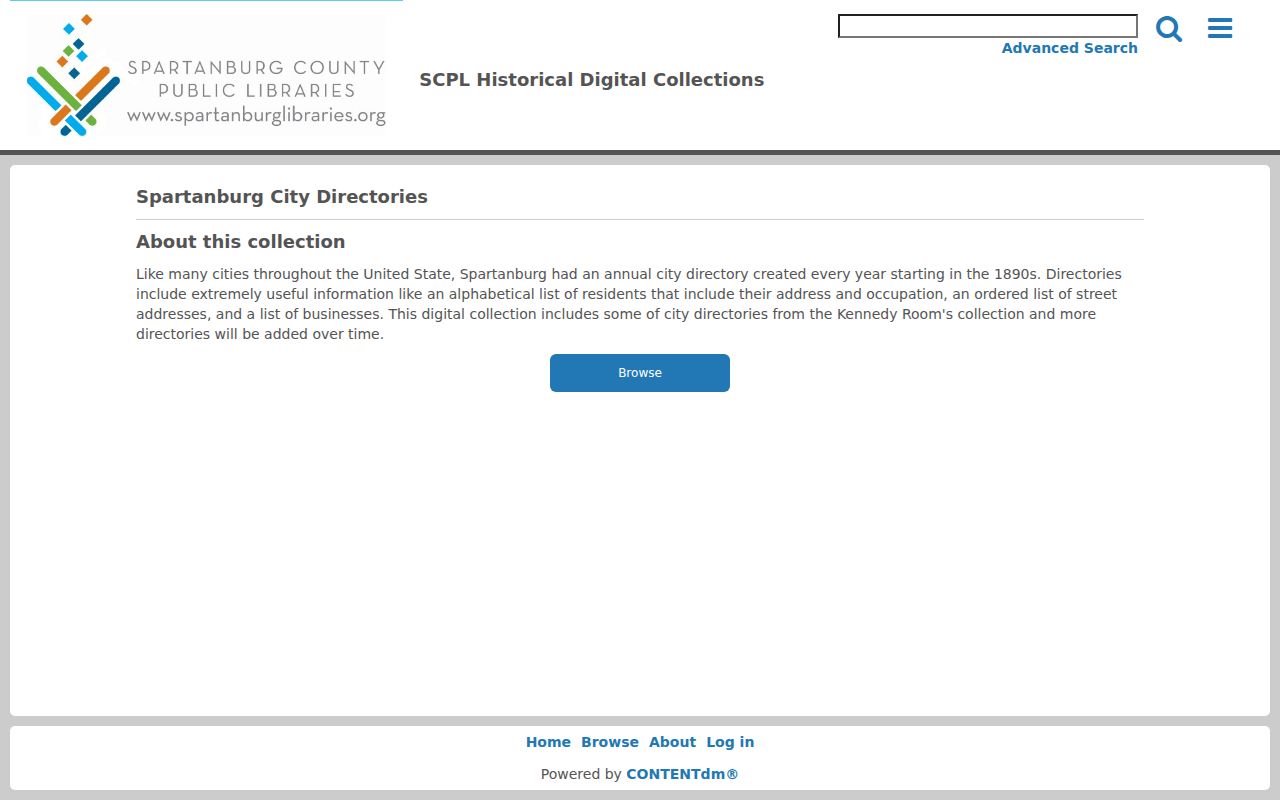
The collection screen shows the online starting point, while the printed pages remain dated historical evidence rather than current resident records.
Kennedy Room and Spartanburg City Directories
The Kennedy Room of Local History and Cleveland Genealogy Department is at the Headquarters Library, 151 S. Church Street, upper level, Spartanburg, SC 29306. Its collection reaches beyond directories into books, microform, maps, clippings, manuscripts, visual material, and genealogy databases focused on Spartanburg County and the region. Appointments made at least 24 hours ahead are recommended so staff can pull material; walk-ins receive assistance when room and equipment capacity allow. Staff information lists 864-596-3500 extension 1238 and appointment support at 864-596-3508.
Posted hours are Monday through Thursday 9 a.m. to 8 p.m., Friday 9 a.m. to 6 p.m., Saturday 10 a.m. to 1 p.m. and 1:30 p.m. to 5 p.m., and Sunday 1:30 p.m. to 5 p.m. The Kennedy Room also has a remote route. Its Distance Researcher Form supports limited staff work in newspaper, probate, land, military, family-history, and local topics. The current form lists a $5 service fee per request, up to five copies per two weeks, and roughly a two-week turnaround. Payment is by prepaid check or money order, or by card after invoice.
The form is a useful human-access channel when a scan leaves a question unanswered. It avoids treating a single digital hit as the whole collection. The Kennedy webpage retains an older ten-copy statement, so the newer form’s five-copy limit is the safer current detail. Note: Give staff the exact name, year, address form, and any page or newspaper citation already found.
Start with the Kennedy Room’s local-history page when arranging access or a request.
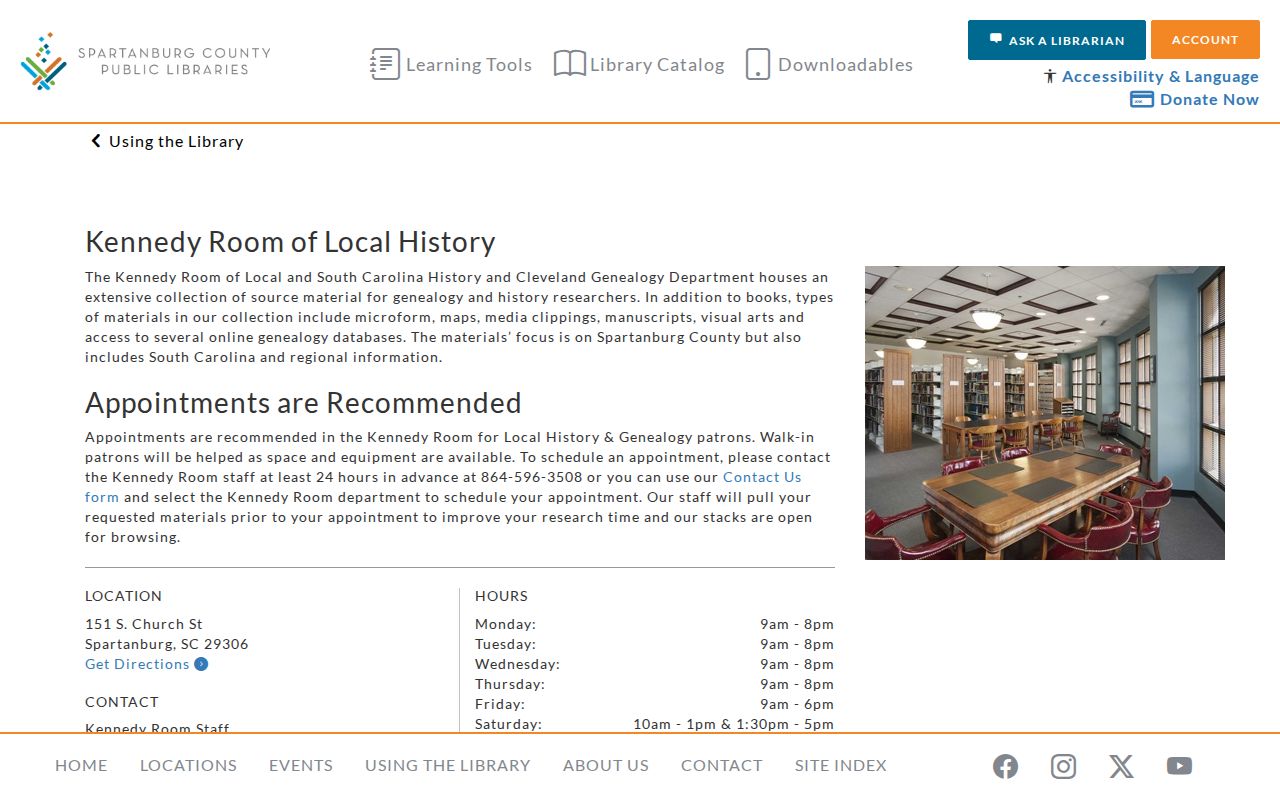
The library is the physical fallback for directory gaps, microform, maps, and staff-guided historical research.
Reading a Spartanburg City Directory Entry
A Spartanburg printed directory entry is best read as a compact, dated notation. The collection description supports alphabetical resident listings, an ordered street-address section, and business listings. Scanned examples support personal or business name, residence address or street context, occupation or business affiliation, and a business-office location where relevant. Some entries contain lodging clues such as a boarder or hotel notation. The printed page does not certify legal ownership, current occupancy, or a complete household.
| Name | Transcribe the personal or business name exactly as printed, including initials and spelling variants. |
|---|---|
| Address | Keep the street form and any cross-street context; older address numbers may not align with a modern parcel. |
| Occupation or affiliation | Read it as historical work or business context for that volume year, not a current status. |
| Lodging clue | Boarder or hotel notation may help separate similarly named people in the same period. |
| Directory placement | Resident, street-address, and business portions can lead to different forms of the same name. |
- Street-address section
- The ordered address portion named by SCPL, useful for comparing printed locations in that one volume.
- Abbreviation key
- The volume’s own explanation of shortened printed terms. Check it before expanding a notation in a research note.
- Dated appearance
- Evidence that a name or business was printed in a particular edition, not proof of ownership or present residence.
No verified local modern reverse or criss-cross collection was found. It is therefore inaccurate to call the digitized volumes a reverse directory. For a current address-keyed record trail, use the Spartanburg Street Directory instead of forcing historical pages to answer a modern question.
Spartanburg’s 1923-29 Index Gap
The Kennedy Room’s obituary and death-notice index begins with the July 17, 1844 Carolina Spartan and continues into current Spartanburg Herald-Journal material. Its stated gap is 1923 through 1929. The related News Index covers 1915-22, 1931-37, 1950, and 1960-present, and it remains in progress. A search with no result in either incomplete run is not proof that a person, death, or address never appeared in the paper.
The death index has search controls for last name, first name, middle name, spouse, age, and location, with general and specific search modes. Results can include alternate names, age, residence or location, spouse, date and page, source, death information, and entry number. Those fields are clues for a newspaper citation or staff retrieval. They are not a current-address tool and should be kept beside the directory year when tracing a person.
Use the Kennedy obituary and death-notice search after a directory name disappears or changes. The index can turn a dated directory entry into a newspaper or microfilm lead without pretending that an absence resolves a family question.
Trace Spartanburg City Directory Families
Use a household trail in sequence. Transcribe the name and address exactly as printed in one selected directory. Compare the closest available digitized volume before and after it. Then pair the directory with the nearest released federal census, which currently reaches 1950 under the federal 72-year release practice. The census is a separate household snapshot, not a present-day record. A move, a changed spelling, or a name missing from one edition is a reason to look for the next record, not to silently treat two people as the same person.
- Choose an available Spartanburg directory year and copy its wording, street form, and page reference.
- Review the closest volume on either side to test continuity, a move, or a changed occupation listing.
- Use the nearest released census for household composition, age, birthplace, and address context.
- Search the Kennedy death or news index for a family transition, keeping its date and source citation.
- Check a deed or probate trail when ownership, heirs, or estate property must be verified.
That sequence keeps each source in its proper time. A directory provides a dated address and occupation appearance. A deed documents a recorded transfer. Probate material can identify an executor, heir, or estate property. The difference is useful when an old parcel changed hands while a household remained, or when a surname leaves a directory after a death.
Spartanburg City Directory Archive Paths
The South Carolina Department of Archives and History offers a Research Room and online-index routes for selected historical material. Its Spartanburg County guide identifies estate papers from 1787-1900, will books from 1810-1903, real-estate probate papers and books from 1825-1904, voter-registration books from 1882-1897, and deed-related series. These are holdings statements, not a guarantee that every page is online. An index hit may still require the Research Room or a request.
Other local channels add context rather than a substitute household roster. Wofford Archives & Special Collections has appointment-based church, map, and institutional material. Its Local History Digital Collection holds historic city views and maps, useful for reconciling street forms and the built environment. The Spartanburg County Historical Association provides local-history contact, but no searchable personal directory was verified.
Visit the SC Archives research-services page before pursuing an index or request.
The archives route helps continue a historical question after the local directory shelf and online scan no longer supply the needed period.
Spartanburg City Directory Record Care
Spartanburg County was formed in 1785, and the State Archives lists older conveyance, plat, probate, and voter-registration series that predate the digital city-directory volumes. The city’s municipal guide also identifies tavern-license bonds from 1837-51 and Municipal Court dockets from 1910-76. Those materials can add context to an old downtown address, but they are not resident rolls. Historic districts and changing streets can also make a literal modern-address match unsafe.
Use historical directories for family history, reconnection, estate questions, and careful local history. Do not use a historical listing to track, harass, or harm a living person. The printed source, the date, and the custodian’s limits all belong in the research note. Note: A historical address is strongest when it is retained exactly as printed and compared with a second dated source.